
Just like our ‘collecting stories’ series, a day in the life aims to de-mystify the art world, highlighting real-life stories of a typical day.
Join us as we follow Thomas Martinez Pilnik, founder of Los Angeles-based Feia, through a day of creating a cultural hub in the purpose-built space behind his home, visiting artists’ studios, archiving work, and reflecting on his diverse background in art and academia.
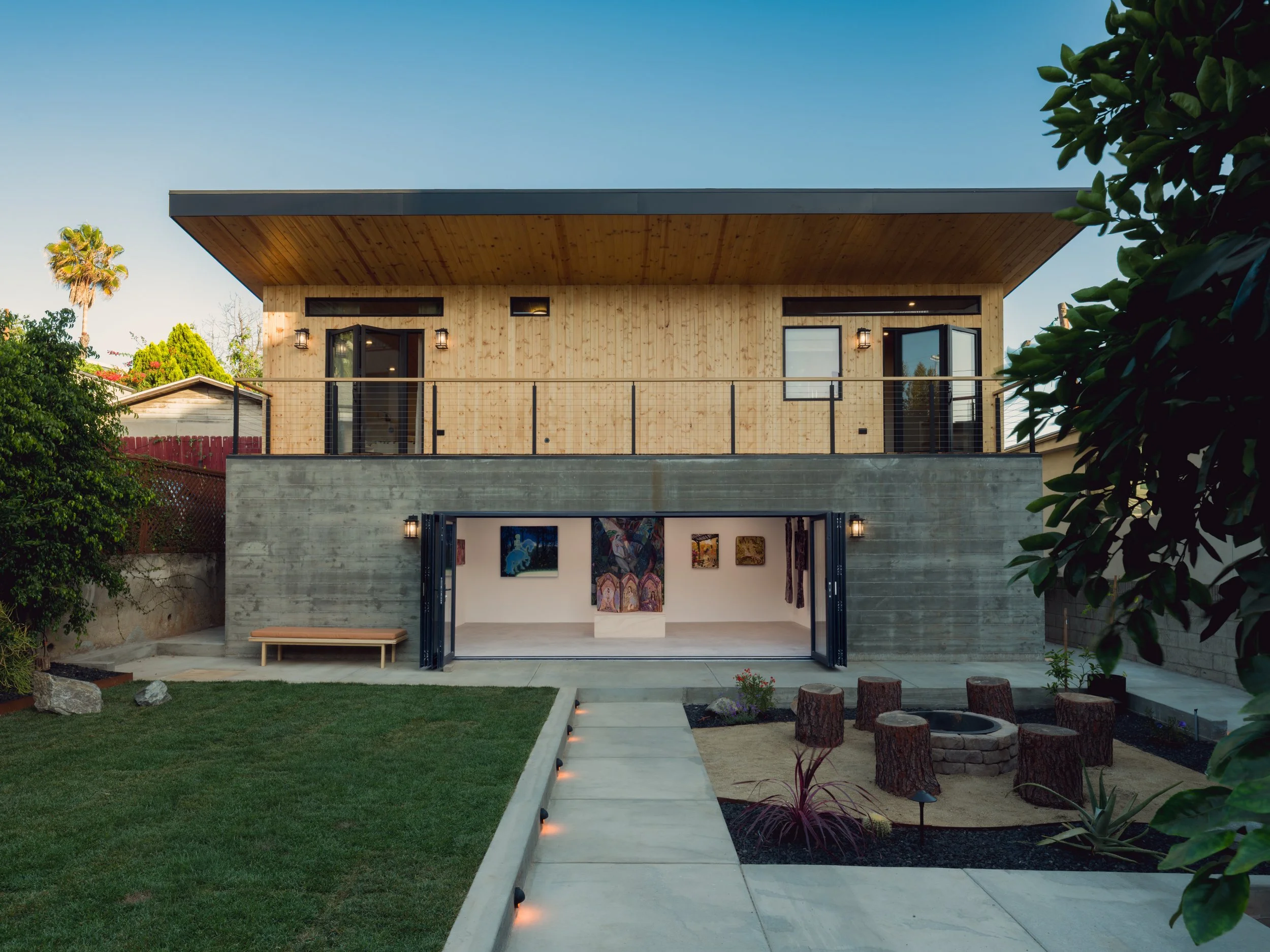
Image: Feia Gallery. © Nice Day Photo/Coley Brown.
Feia sits in Northeast LA, on the border between Highland Park and Eagle Rock. Conceived and built by husband duo Thomas Martinez Pilnik and Jake Cavallo, the gallery opened in May 2026 and has already had a breakout year. Moving between functional and non-functional art and collectible design, Feia offers three spaces that each invite a different way of engaging with art: the gallery, the flat upstairs, and the rooftop.
During their September installment, Korean Canadian artist Jeannie Rhyu took over the downstairs gallery; the more formal of the gallery’s two indoor spaces. Her show, “Sixth Ocean, Eight Sea,” consisted of oil paintings and ceramics that drew on her background in printmaking. Upstairs, Los Angeles-based artist Patrick Arnold transformed the space with large-scale ceramic sculptures and quilts that straddled the line between functionality and design in his solo show, “A Mansion Has Many Rooms.” Both shows concluded on October 18, 2026.
We were able to sit down with Thomas in his warm and inviting space on a sunny day in September; below is our interview.
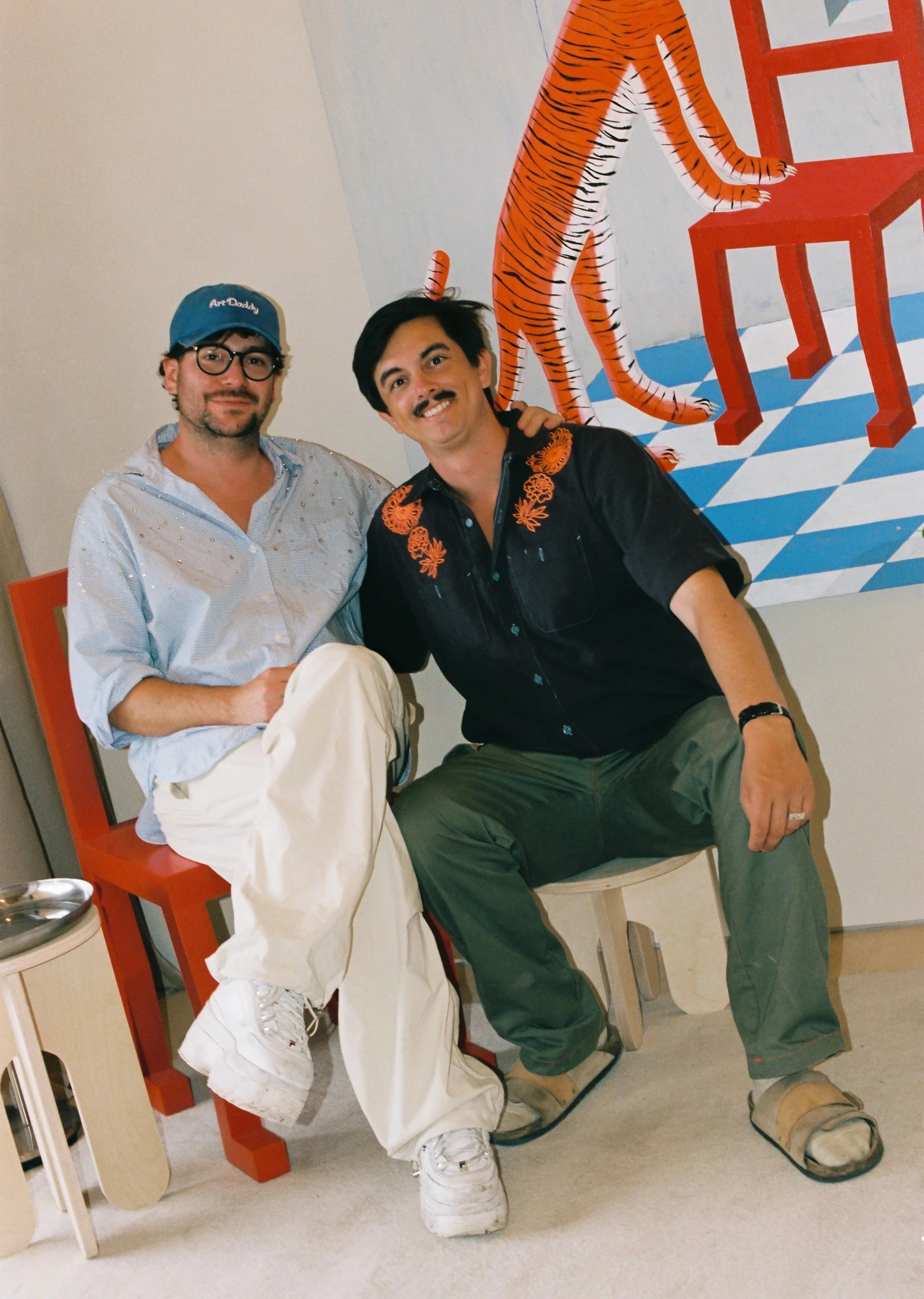
Image: Thomas (left) and Jake (right). © Claire Preston.
Tell us the story behind the name “Feia” and its Portuguese translation “Ugly”
Feia means ugly in Portuguese. My family is originally from São Paulo, Brazil. I grew up in London, and I am now settled in Los Angeles after some time in Virginia, New York, and Connecticut. As we were growing this venture, I really wanted to honor my ancestry and family and share funny memories I have with them. I would bite my nails as a kid, and my mom would slap my hand out of my mouth and say “que coisa feia,” which translates to “what an ugly thing.” But in the same breath, it is seen as cute, just like a scraggly dog. Que coisa feia, what a cute thing.
So where English is limited, I think on occasion Portuguese is quite poetic. There was something cheeky and fun about calling the gallery ugly, while still leaving space for us to do what we do best: celebrate imperfect art, craft, obsessiveness, and things that may not be traditionally beautiful but are compelling.
What path led to you and your husband Jake Cavallo opening the gallery? Can you give us a little behind-the-scenes of the space?
I was about to move to San Clemente in Orange County for a job in an art residency. I had rented a studio space off the main road, and unfortunately, the residency went under right before I was supposed to start. I hadn’t yet moved from downtown LA, but I was left with this studio space. I wanted to use the space instead of letting it sit for a year, so I moved my kiln and ceramics practice down there and incorporated Feia as an LLC. I opened a ceramics workshop, hosted classes, and it was the genesis of it. Over time, we started working with galleries up here, intervening during their downtime to host events, activations, and food-based things. This began to spiral into working more directly with artists, doing a few SPRING/BREAK Art shows, applying for art fairs, and realizing that I really liked being an art dealer. After transitioning out of the space in San Clemente and moving into our house in Highland Park, all the pieces of the puzzle just started to fit together.
What does the first hour of your morning look like? Are you up with the sun or snoozing the alarm?
I am not up with the sun. I have trained myself against snoozing but rise when I rise. My husband is out the door at 6:30 every morning, and I am not. I will snuggle with the dog and get up around 8:00 or 9:00.
Highland Park has no shortage of great coffee shops. Are you brewing at home or is there a go-to spot you swing by? What’s the order?
I wish I were a regular like that! Unfortunately, we’re a little far from anywhere to be super regulars. Although big shout-out to Amara Kitchen, I’ve been three times this week, so maybe that’s starting to take the win. But no, I drink coffee at home, I have a very particular breakfast routine. I then have to cut myself off. I can only have two coffees a day, otherwise, I'll be shaking.
Since your Gallery is based out of your home, is there something you do that switches you from home mode into gallery-director mode?
Very fluid, learning to draw boundaries. This is a job that doesn’t really go to bed. For people who know the art world, there is very little separation between art and your life. I am asking people to live with work, to understand work, to come here and be embedded in Feia, and Feia is me. There’s very little separation by design. I’m hoping that people trust our taste and trust what we do and want to be here, so I tend to answer calls and texts as they come in. I am definitely learning when to turn it off. But again, because that distance is so close, the thing that we really do is protect the house itself. That is not a Feia space; it’s not a space I bring people into, unless it is for a friend’s event and not a Feia one. I think having that separation of space matters a lot, but in terms of designation of time there is none…but please don’t text me at three in the morning.
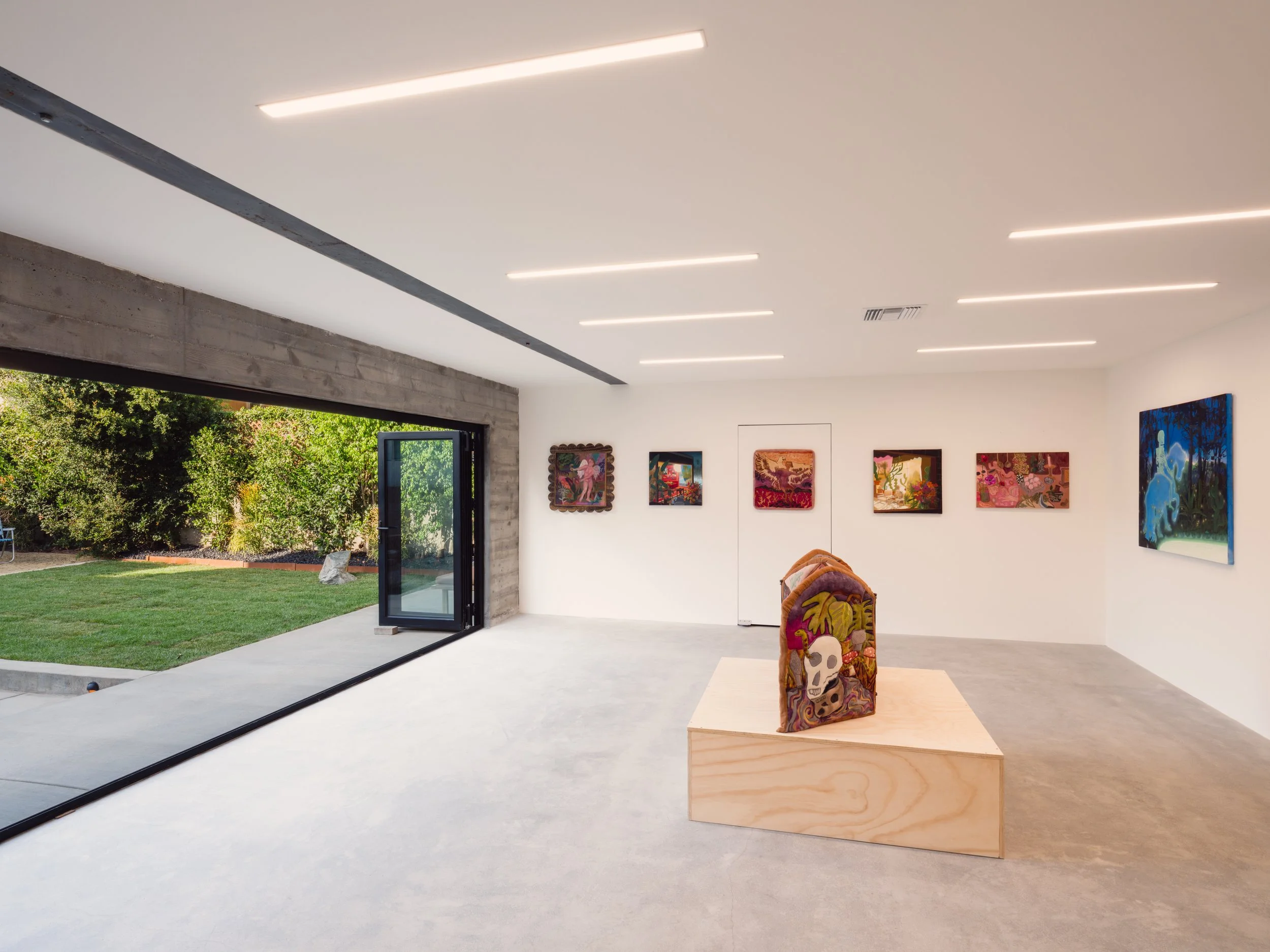
Image: Interior of Feia . © Nice Day Photo/Coley Brown.
Tell us more about the build out of the space; how did it come together?
We built this building from the ground up. It’s an ADU (Accessory Dwelling Unit). I spent four months designing it with my husband, Jake Cavallo, who is an art director for film but trained as an architect. There are a lot of things that are really custom to both our tastes, but also for day-to-day operations of the gallery. We wanted the story of the building to be part of the gallery itself: the exposed concrete, the big windows, the rawness paralleled by the warmth of upstairs. Then there are basic functions: a secret door, which leads to our somewhat organized storage room. As we build our sense of self, we actually have inventory now, and we can bring works to fairs and show people our identity.
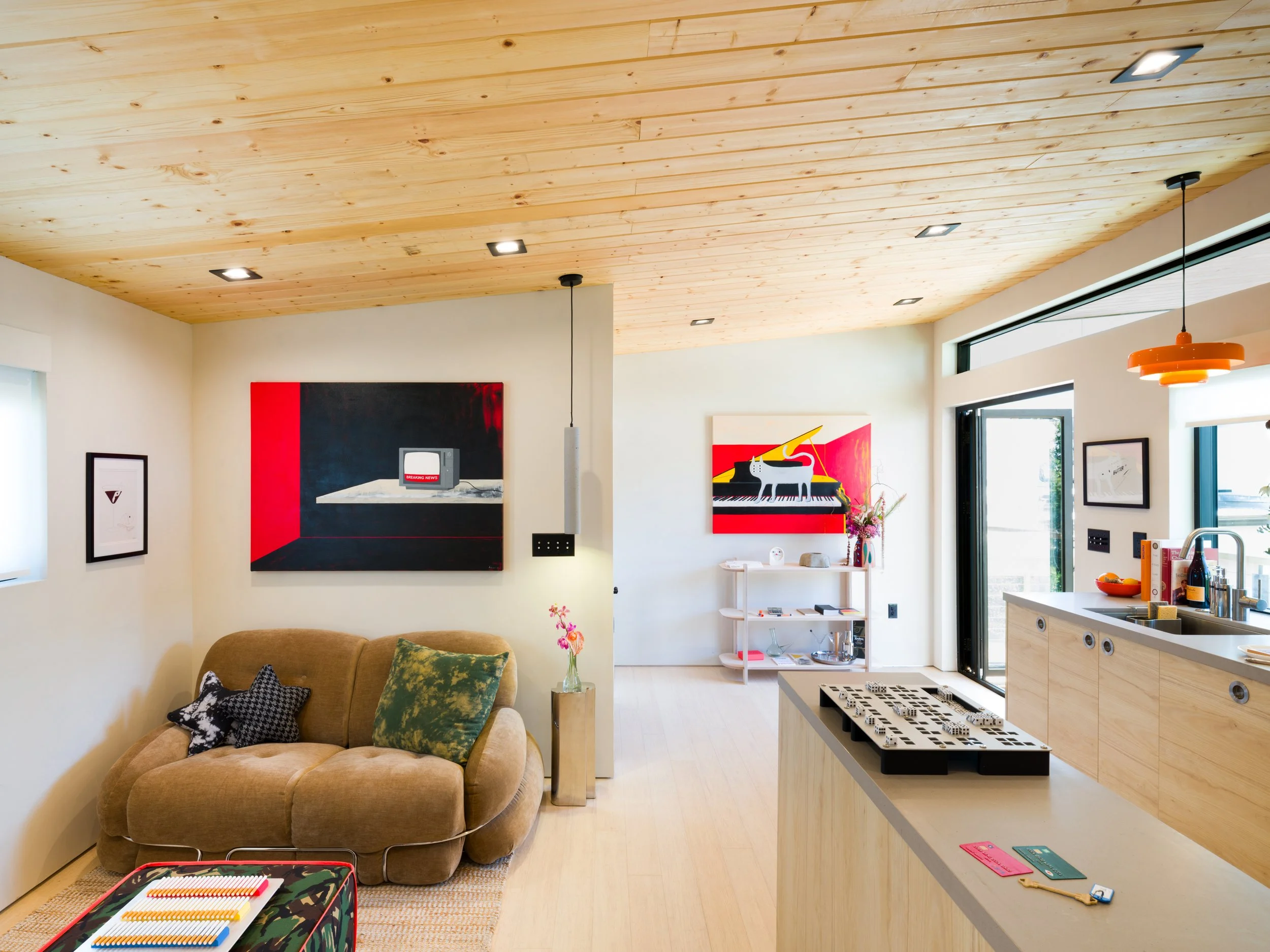
Image: Upstairs at the Feia Flat, art by Tadashi Adamson. © Nice Day Photo/Coley Brown.
Playlist, podcast, or silence? What’s the soundtrack to your workday?
Silence, dead silence. I think we all are constantly inundated and constantly overwhelmed. I operate in quiet; I don’t play music at home or have shows on. I will listen to The Daily in the shower, but other than that, I am with myself and need time to be able to think.
Walk us through today’s to-do list.
This was most important! But I do have kind of a fun day planned. We are a few days away from me going to Houston to show Charles Hickey’s work at Untitled Art, so I’m wrapping up some logistics there. Charles had a breakout year with us, so we’re anticipating a really fun time. I love art fairs, and it’s the butterflies of preparation is the exciting part for me. I also have to do a bit of surgery on a work. Because I was a ceramicist, I am always down to get into the problem-solving with our artists. We have a work that is a water fountain that needs a little bit of waterproofing before the collector comes and picks it up, so that’s on the agenda today. I reseeded our lawn this morning…then we have another collector coming in who is going to pick up some work and see the new shows. Then I am off to West Hollywood to see a venue where Patrick just painted a couple of benches for a client. It’s quite the day!
A lot of your previous events involve a food element; why are the culinary arts important to you and Jake, and what draws you to incorporating them into the art world?
I think connection is the baseline of it; food is the easiest way to connect with people, for us at least. Whether it’s the act of love in cooking and providing or simply just treating people right. At our openings, we have ordered McDonald's for everyone instead of a traditional charcuterie board (which we have on the side). But the main event is 40 cheeseburgers and 200 nuggets, and the first thing to go at every opening. The vast majority of the time why people leave one of our events is because they need food, so why not just give it to them and give them no reason to leave. There is a little bit of entrapment, but it’s all through generosity.
Jake and I love to be in the kitchen. That’s our shared love language and what we do to feel connected with each other. Being able to share it with others is just part of our ethos and our way of being.
When’s lunchtime? What are you having?
It is when it is. But I do get hangry, so I am very by the book about my food. I have my smoothie in the morning, and I always take a break for lunch. In a weird ritual that has developed over the past year, I watch an episode of The Simpsons. I’ll pull leftovers or make a sandwich and watch one episode from an older season, and it’s twenty solid minutes where my brain is off, and I get to reset a little bit.
Then Jake and I always sit down at the table for dinner. I am generally cooking during the week, and that’s really intentional and something I grew up doing. Going back to your former question, it doesn’t necessarily mean my day is over; I may go back to work, but it’s an important moment to connect and eat.
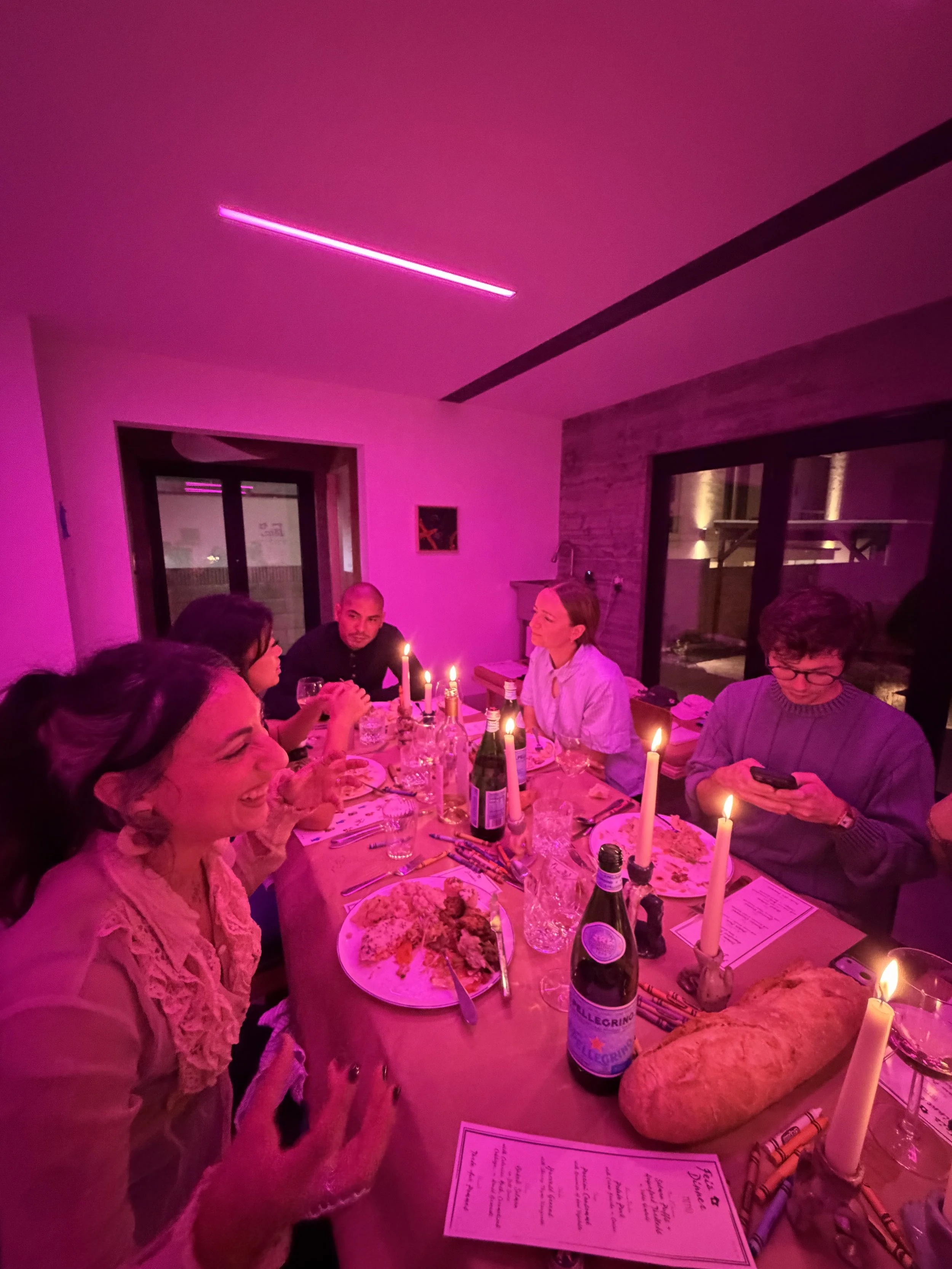
Image: Feia exhibition opening dinner.
Your background is in education; what are some topics you love teaching and/or incorporating into your work?
I have had a few lives.
I moved to the US [originally from Brazil, but grew up in London] to attend the University of Virginia, where I worked for a little bit in the Office of Diversity in the School of Engineering. I was there during Charlottesville's troubled period when the Unite the Right rallies happened, which then led me to get my Master’s of Education at USC, bringing me to LA. My M.Ed. was in Postsecondary Administration and Student Affairs. I was really interested in the system and structure of higher education. My concentration was in Critical Race Theory, and this was during the time that CRT was much maligned in the media for no good reason. It is interesting to see how all of that has informed my praxis as a curator and a dealer. CRT is a legal theory, so there’s not a lot of practical application, but there’s a lot of intellectual application involved with curating. How do I look at the diversity of our program? How do I look at the full breadth of what we’re putting out in the world, not just from an identity perspective, but from the medium diversity, from the intellectual diversity, the curiosity of thought? The way that work intersects with other work, and how we program vertically in the space. Do we have geographic diversity? And are we always connecting ourselves back to our internal community? We always try to have an artist from L.A. if we have an artist from out of town. All of this goes into our curatorial philosophy.
The background in education really helps with the fact that most of my job is educating folks on the work we’re showing. For someone to be convinced of a work, I think they have to know about it, and to know about it is then to hopefully love it. So much of what I do is demonstrating why this work exists, why this artist is in the world making and alchemizing these things. I think it’s been integral to how I operate as a dealer and has worked really well in lieu of my career that I never had in galleries.
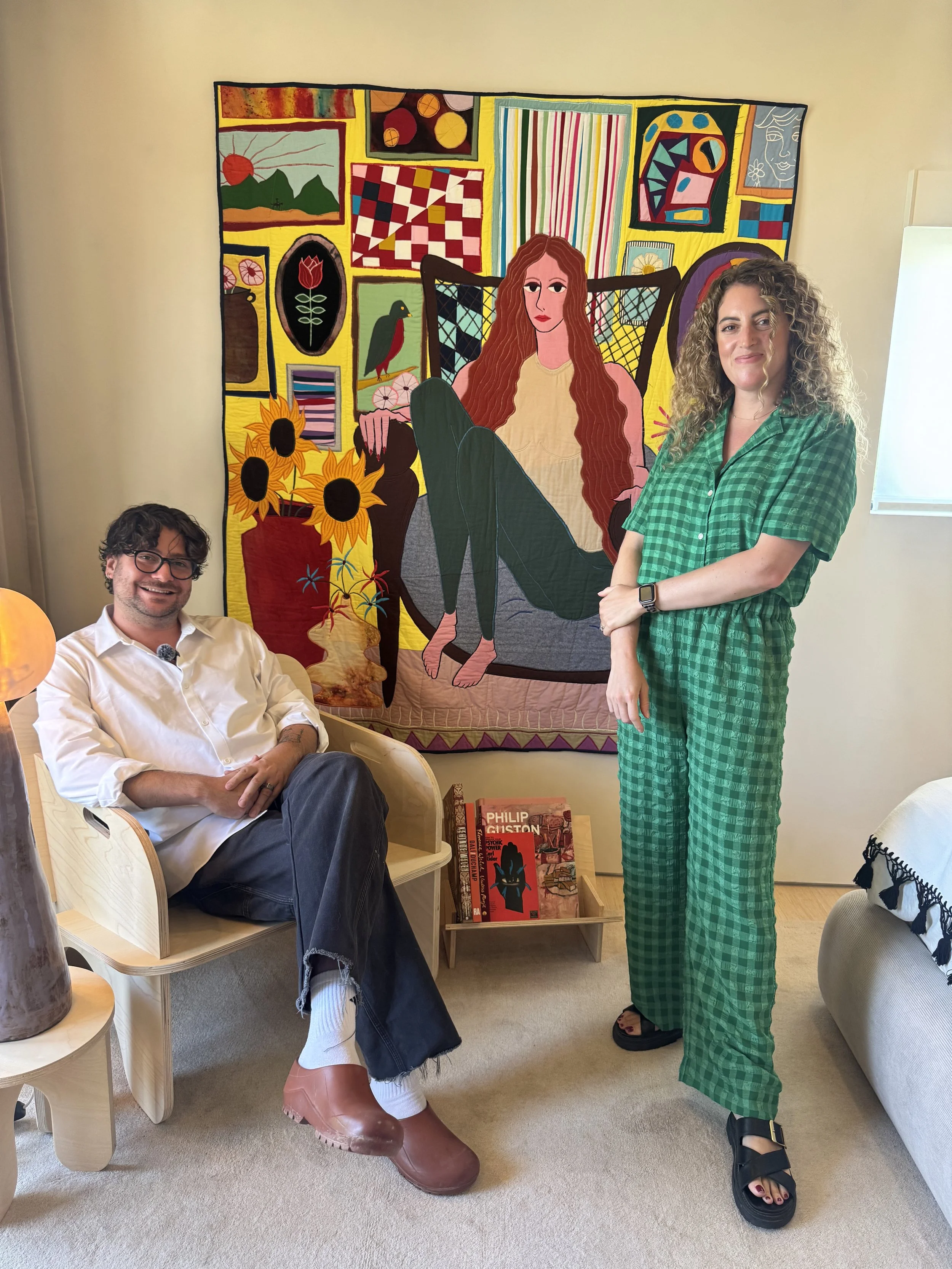
Image: Thomas Martinez Pilnik with Liza Shapiro featuring artwork by Patrick Arnold in the Feia Flat.
Outside of art and academics, what is the accomplishment you’re most proud of?
This was the question that I knew would be difficult to answer since so much of my life has been both art and academics. But I think one thing that I’m most proud of is that I get to have my little family and be here in this community and live in my house with my dog and my husband and get time to do just that. Time to go see a silly show at the Hollywood Bowl or have a night in with the puppy, all that feels treasured and special. To have the little life alongside the big life. I am really interested to see how far we can push Feia. I am without a doubt a workaholic and a careerist and want to serve our artists to the best of my ability. So much of what I am proud of is right here.
Any end-of-day rituals to bring the workday to a close?
We don’t end the day too early, but we don’t start it too early either. Sitting down at the table for dinner with Jake, getting 30 - 40 minutes to chat, decompress, gossip, and of course talk about whatever happened in the day. Then throw on an episode of 30 Rock or Gilmore Girls and just turn off the brain.
What are you looking forward to this year and next?
So much! This year has really been the beginning, and we still have Untitled Art fair in Houston and two more shows after our current ones, both down and up. Annie Duncan, Marianna Peragallo, Raina Lee and Reniel Del Rosario come through October into December. Then we will cap off the year in Miami at NADA with artist Ben Cabral and Melanie Delach, which I can only describe as the most insane thing we’ll do in a while. Ben has made a fully functional six-foot bedazzled carousel that is going in our NADA Miami booth. So, stay tuned for that.
Next year, I am just excited we will get a full year of Feia. Off the bat, from January onwards, we get to be here and steady ourselves, charting the course and finding solid ground.
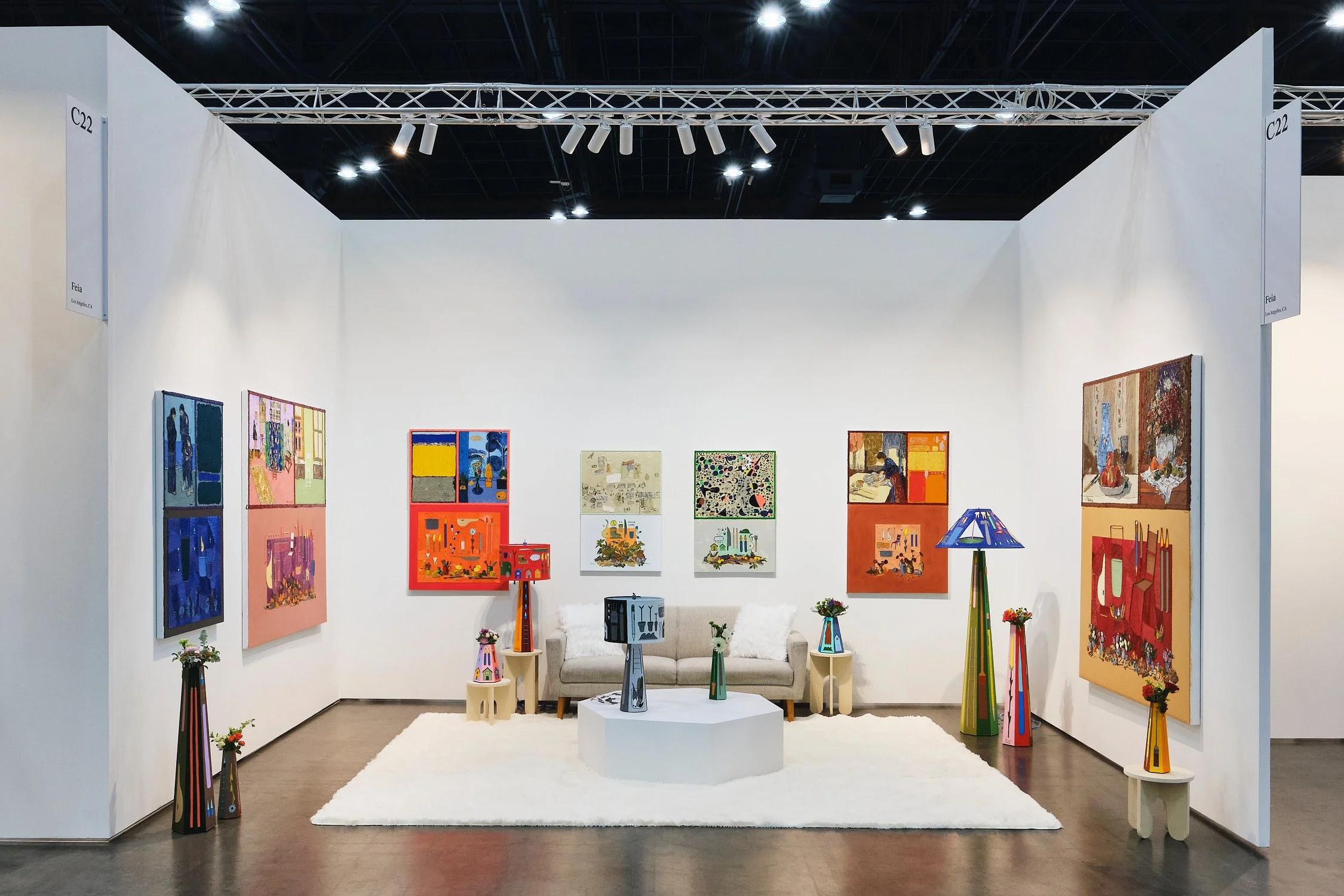
Image: Feia at Untitled Art, Houston, featuring artist Charles Hickey. © Chris Hanke.
If you would like to schedule an appointment to visit Feia and see their November show featuring artists Marianna Peragallo and Annie Duncan, please reach out through their appointment link below.